There’s a huge amount of stories competing for our attention. This could create a sense that a new work will stand out more by having novel ingredients. Yet, if these start to feel overdone, or inessential, an audience could find novelty diluting a tale’s potential impact.
Regrettably, this is often the case for The Memory Mirror by Georgina Luck, a play that’s notionally about a paramedic with a history in the Blue Mountains area. This is our protagonist, Daniel (Gabriel Partington), who, in the present, is amongst a group of paramedics working at a counter-culture festival “in the heart of the Blue Mountains”, although unlike something like Picnic at Hanging Rock, we don’t really get a particular sense of place here.
The festival site is adjacent to a river where a tree holds the titular mirror. An aside that felt more academic footnote than organic dialogue advised us of the Italian inspiration for the mirror’s installation. It was also noted that the mirror shows the river appearing to flow backwards … which seems more related to an optical illusion than memory. Regardless, the suggestion might have been arrived at more crisply, and been more effective, if shown rather than spoken about. That standard piece of advice on theatre-making wouldn’t be followed so closely in the tale to follow. Our protagonist has a lot to tell us.
Before we could get too concerned by the river-flow metaphor, we were given a quick tour of the local community and festival mainstays. There’s an older couple – the Monros. Mr Monro (Jim Daly) teaches on memory techniques, and is a long-running winner of the festival’s memory contest, which initially came across as a local-trivia event, which is a bit disorienting. Mrs Monro (Margot Knight), is considered by her husband to be an improving student of his methods. For some reason, she can struggle in his presence, although she taught Daniel a useful trick some years ago when he was a trainee. Festival MC Banjo (Don Bridges) makes various manic appearances as he fusses about the running of events.
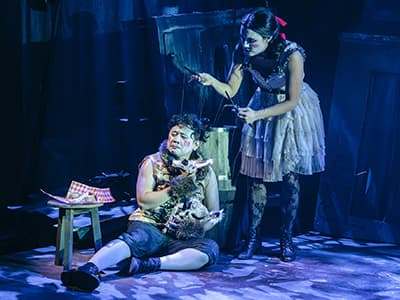
Watching from afar are Huginn and Muninn, two black birds (possibly cockatoos, designed by Scout McDonald, animated by puppeteer Charlie Whiter), taking their names from Odin’s information-scouting ravens from Norse mythology. Another explanatory passage told us that Muninn means "Memory", and Huginn means "Thought", further cluttering the memory theme. A little on how this particular quirk came to the local culture could have assisted its integration into the world of the play. Regardless, the birds were clearly trusted by some familiar with the locale; their natural-looking nods helped observers decide on the truth, or otherwise, of assertions made by characters, but ultimately this doesn’t amount to much.
Daniel isn’t usually scheduled for a shift at this festival. Now he’s stationed with two other paramedics: a senior officer, Myra (Anthea Davis), who has seen a lot, and a trainee Pip (Christine Husband) who embraces the fun of the event. These two seem credible in their slight supporting roles.
For a play marketed as being about the burdens of first responders, the lack of consistent focus on this thread was perplexing. For example, we could have Banjo in a colourful outfit, providing an unnecessary comedic interlude when not so much had happened yet. This moment raised a chuckle from a small group in the opening-night audience.
There’s also a mystery element here, but it’s more distracting than convincing as it lacks a coherent internal logic. The play scatters around misdirections to create doubt about some matters, such as whether Mrs Monro is showing mental decline. But as she isn’t the one suffering from dementia, the red herrings of her mistaking salt for sugar in making her famous cakes, or losing her wedding ring on her potter wheel, don’t have a satisfactory explanation, and so erode our belief in the story. Similarly, Mrs Monro’s inexplicable forearm burns are seemingly only here to prompt Daniel to remember a similar, buried incident from his time in the area as a trainee.
Recalling the past gives Daniel a chance to do more acting than was possible with the previous coldly efficient personality shown to us. But it was odd to have him blame himself for past events when it seems that inadequate training was a major contributor to the recalled mishap. Again, believability could be tested when Myra, referring to the history behind Daniel’s usual absence from this festival, says “You can’t put two and two together?” incredulously. Surely a first responder would have a better appreciation of how others can suppress trauma so that they can continue to function?
As credibility steadily trickles away, it likely causes some production blemishes to become more obvious for the viewer becoming disengaged by feeling a certain artificiality of proceedings. Some are smallish matters. The draped fabric used to suggest the paramedic’s tent at the festival is not just near the memory mirror but adjacent to the Monro’s caravan, which seemed implausible. Similarly, seeing the sticks of the shadow-puppet birds in flight breaks the illusion.
Of more concern is Daniel’s tendency to address the audience, even when in conversation with a colleague behind him, when there is no good reason to face us – we’re not having Hamlet’s reasoning with himself through a soliloquy here. Oddly, this caused me to recall seeing A Beautiful Noise recently. I doubt that many would accuse that show of investing too heavily in dramaturgy, but it still had a reason why an older Neil Diamond would spend so much time offering recollections – the therapist office framing. The lack of such framing here adds to the growing pile of distractions. Well before the end it feels as though the paramedic’s story promised is having to compete with too many other elements for airtime.
The play went through a Gasworks “Open Studio” season in 2024. Punters might not know what that means, but might infer that it should have made more use of an editor or dramaturg empowered to challenge a writer and director on shaky structural elements and contrivances. One possible result of the Gasworks time is that the transitions between scenes were handled crisply. Even so, this work regularly feels like a short story that has not been adequately shaped into a play. It would seem that reforming of the work under some heat and pressure will be necessary before it can show us sharper, more memorable images on its advertised topic.
Event details
G Luck Productions presents
The Memory Mirror
by Georgina Luck
Director Drew Tingwell
Venue: Brunswick Mechanics Institute | 270 Sydney Road, Brunswick VIC
Dates: 8 – 13 September 2026
Tickets: $35 – $25
Bookings: https://events.humanitix.com/the-memory-mirror